




Ten Common Punctuation Mistakes in British English
Ten punctuation slips that recur in British English manuscripts — comma splices, apostrophes, quotation marks and more — with practical fixes and a proofreading routine to catch them.
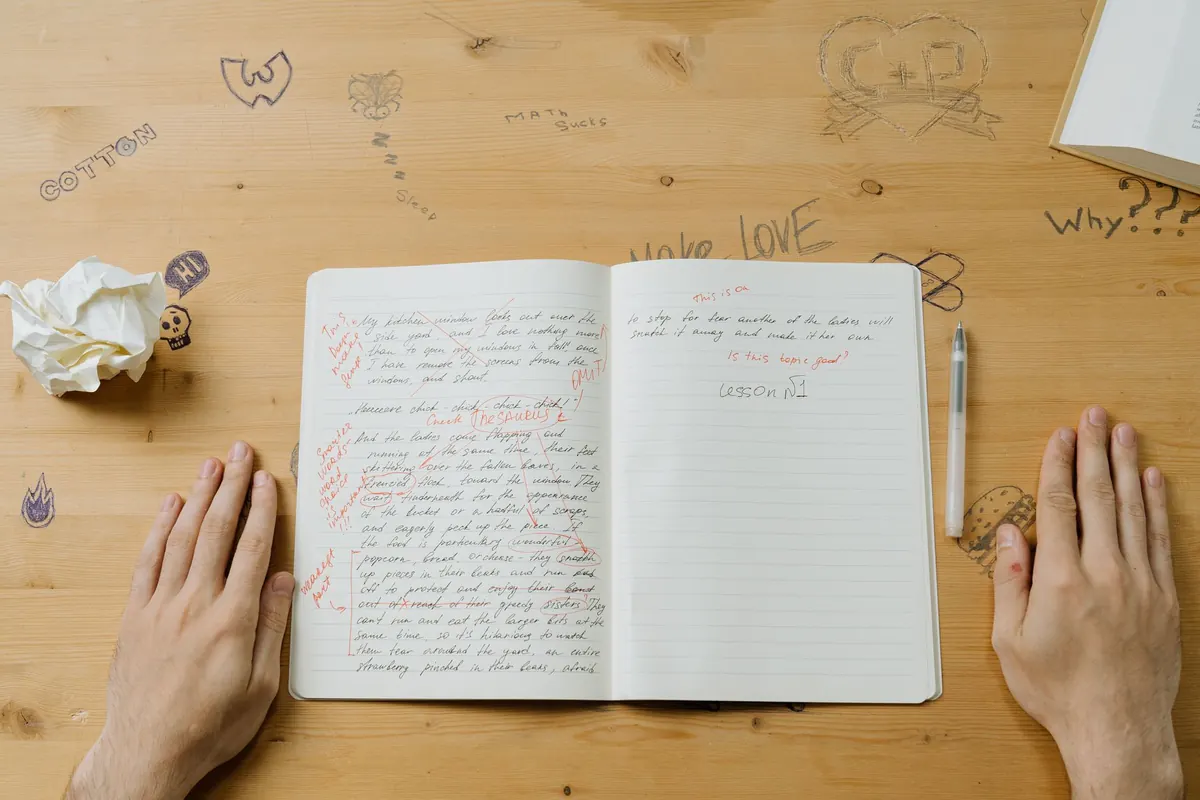
Most punctuation problems are not failures of grammar knowledge so much as failures of attention. A writer who can explain the difference between a colon and a semicolon will still type its when they mean it's at the end of a long working day. British English adds its own wrinkles: where American practice tucks a full stop inside a quotation mark, British practice usually leaves it outside, and our dashes and abbreviations follow their own logic. What follows are ten mistakes that turn up again and again in manuscripts, along with fixes you can apply the moment you spot them.
1. Comma splices and run-on sentences
A comma splice joins two complete sentences with nothing but a comma:
The draft was strong, it needed a sharper opening.
Both halves can stand alone, so a comma cannot do the joining. You have three repairs. Use a full stop: The draft was strong. It needed a sharper opening. Use a semicolon: The draft was strong; it needed a sharper opening. Or add a conjunction: The draft was strong, but it needed a sharper opening. The semicolon version is the most elegant when the two ideas are tightly linked, but it loses its effect if every second sentence carries one.
2. Apostrophes: possession, plurals and the it's trap
The single most common slip in British English is it's for its. The apostrophe stands for missing letters, so it's means it is or it has, and nothing else. Possession takes no apostrophe: the company lost its edge.
For nouns, the apostrophe goes after the final letter of the owner.
- Singular: the editor's notes, the writer's desk.
- Plural ending in s: the editors' notes, three weeks' work.
- Irregular plural: the children's books, the women's section.
- Names ending in s: British style usually adds 's — James's notebook, Bridget Jones's diary.
Plurals never take an apostrophe. Three MPs, not three MP's. Decades are written the 1990s, not the 1990's. The apostrophe only appears when you shorten the digits: the '90s.
3. Quotation marks: where British practice differs
Traditional British style uses single quotation marks for speech and quotations, with double marks for a quotation inside a quotation. Plenty of UK publishers now set double marks as house style, which is perfectly acceptable — the important thing is to choose one and hold to it throughout a document.
Placement matters more than shape. In British style, a comma or full stop sits outside the closing mark unless it belongs to the quoted words:
She called the draft 'a mess'.
He asked, 'Is it finished?'
In the first example the full stop punctuates the whole sentence, so it stays outside. In the second the question mark belongs to the quoted question, so it stays inside. If you are quoting a single word and the sentence continues, no punctuation goes inside the marks at all: She described it as 'unfinished' and moved on.
4. Colons, semicolons and dashes
A colon introduces; a semicolon balances; a dash interrupts.
Colons
Use a colon after a complete clause, then lower case in British style unless a proper noun or a full sentence follows: There was one problem: the deadline. Avoid putting a colon straight after a verb or preposition — the options are: ... reads awkwardly, so write the options are these: ...
Semicolons
They join two independent clauses that belong together, and they separate list items that already contain commas. Two per page is usually plenty.
Dashes and hyphens
British style usually sets an en dash with spaces – like this – for a break in thought. The closed-up em dash—like this—is the American habit. A hyphen is only for compound words: well-edited, twenty-page. Mixing all three in one document looks careless.
5. Commas that do too little and too much
Commas are where confident writers and nervous writers part company. A few reliable rules cover most cases.
- After an opening phrase: After two rounds of editing, the piece read cleanly.
- Around extra information: My editor, who lives in Leeds, replied at once. Remove the commas and you change the meaning to the editor who lives in Leeds rather than some other editor.
- Never between subject and verb: The paragraph, that follows is wrong on two counts.
- Before however when it joins clauses, use a semicolon or a full stop: The draft was good; however, it was late.
The serial comma is optional in British English. Use it when it prevents ambiguity — to my editor, a poet and a cyclist could be one person or a list of three, and one extra comma settles it.
6. Small marks that cause quiet distraction
Indirect questions take no question mark: She asked whether the piece was ready. Ellipses are three dots and no more, used for genuine omission or trailing off, not for vagueness. Check that your software has not curled a closing single quote in place of an opening apostrophe in '90s or 'twas. British style generally drops full stops from contractions and acronyms: Mr, Dr, BBC, eg, ie. Brackets take a full stop inside only when the whole sentence sits inside them. And one space after a full stop, never before it — two spaces is a typewriter habit that survives in far too many documents.
7. A proofreading routine that catches these
- Search for it's and test each one against it is.
- Search for a comma followed by it, this, they or there; most hits will be comma splices.
- Count quotation marks. An odd number means a missing one.
- Read the last version aloud. Your ear catches missing commas and splices faster than your eye.
- Change the font size or read on a different device before you publish.
- Keep a short style sheet of your own decisions — single or double marks, serial comma or not — and check against it.
None of these habits takes long, and none of them requires you to memorise a grammar textbook. They simply make you look at the page again with fresh attention, which is what editing is. Pick the two or three errors you commit most often, run those checks on every piece you finish, and the rest will follow.
Photo: cottonbro studio / Pexels