

How to Set Up a Distraction-Free Writing Space at Home
Practical tips for building a quiet, well-lit writing space at home — from desk height and lighting to noise control and software that stays out of the way.

Most writing problems that look like discipline problems are really setup problems. The blank page is rarely the obstacle; more often it's the chair that leaves your shoulders aching after forty minutes, the radio bleeding through the kitchen wall, or the browser tab you opened "just to check something". Fix the room and the writing becomes easier — not effortless, but easier. A distraction-free space at home doesn't need a spare bedroom or an expensive desk. It needs a little thought about light, height, sound and software, plus a willingness to treat your writing time as worth protecting.
Put your desk at right angles to the window
Lighting is the part of a writing setup that people notice last and suffer from most. Sit facing a window and you'll spend the morning squinting into glare while your screen turns into a mirror. Sit with your back to one and you cast a shadow across your own page. Both are tiring in ways you won't immediately connect to the window.
The usual fix is to place the desk so the window is at your side. You get daylight without the contrast problem, and the room feels less like a cave by mid-afternoon. If you write longhand, put a lamp on the opposite side to your writing hand — on the left if you're right-handed — so your hand doesn't shadow the line you're working on.
A single overhead bulb is rarely enough for a desk. A small adjustable lamp aimed at the wall behind your screen gives soft, even light without reflecting in the glass. In the evening, shift towards a warmer, dimmer setting; harsh white light at ten o'clock makes it harder to settle into a long paragraph.
Set the desk up for two hours, not ten minutes
Height does more for concentration than decoration. When you sit, your feet should rest flat, your elbows should bend to roughly a right angle, and the top of your screen should sit near eye level. If you work on a laptop, that last point is impossible without a stand and a separate keyboard, which is the single most useful purchase most home writers can make.
Then keep the surface honest. A working desk holds the things you'll reach for in the next hour:
- laptop or notebook, raised to eye level
- a proper keyboard and mouse, if you use a stand
- one notebook and one pen for stray thoughts
- a glass of water
- headphones, within reach
- one reference book, at most
Everything else goes in a drawer. The mug collection, the pile of post, the charging cables for devices you aren't using: they're all small invitations to look away. A clear desk is not about aesthetics — it removes decisions. And if you can only upgrade one thing, make it the chair. Your back will be in it for far longer than your eyes will be on the desk.
Make noise predictable rather than silent
Absolute quiet is unrealistic in a shared house, and chasing it becomes its own distraction. Traffic, neighbours, a washing machine: these are manageable if they're steady and familiar. What interrupts writing is unpredictability — the sudden door, the phone call, the dog.
So aim for consistency. Close the door if you have one. Soft furnishings, a rug, a bookshelf against the shared wall all absorb sound. Headphones do the rest, and they double as a signal to anyone else in the house.
What you play matters. Many writers find that lyrics compete with the part of the mind that's shaping sentences, so instrumental music, ambient sound or a neutral hum tends to work better than a favourite album. Others prefer nothing at all. Try the same soundtrack each session for a week: the association does half the work of getting you started.
If the noise is people, solve it with a conversation rather than equipment. "I'm writing from seven till nine" is easier for a household to respect than a door slammed in frustration.
Pick software that gets out of the way
Any writing program will do the job; the one that helps is the one you stop noticing. Full-screen or focus mode is the feature worth checking for first, because it hides menus, toolbars and the tempting sidebar of other documents.
A few habits matter more than the choice of tool itself:
- Draft in a plain, quiet space — a simple text file or a word processor in focus mode — and leave formatting until editing.
- Keep editing and drafting in separate tools if you find yourself fiddling with fonts instead of writing.
- Turn off notifications for everything except the document in front of you.
- Work in a browser profile signed out of social accounts, or write offline.
- Put the phone in another room, not face-down on the desk.
Autosave and version history are worth having, so a crashed session doesn't cost you an afternoon's work. Beyond that, the most elaborate app in the world won't write the paragraph for you. If a tool has more features than you actually use, it's fine to simplify.
Let the room carry a routine
A space becomes a writing space through repetition. Switch on the lamp, fill the glass, open the notebook, start the same playlist. Within a fortnight those small actions begin pulling you into the work before you've consciously decided to concentrate.
End sessions deliberately too. Save the file, clear the desk, and write one line about where you're going next. Tomorrow's first sentence is much easier when today's version of you left a note.
Protect the time as well as the space. If a housemate or partner knows that headphones on and door closed means "not now", you'll be interrupted far less often, and you won't have to be short with anyone to make the point.
Start with the two changes that cost nothing
If you do nothing else, turn the desk side-on to the window and put your phone in another room. Those two adjustments alone will improve most home writing setups, and they take about five minutes.
From there, add one thing a week: a lamp, a stand, a pair of headphones, a plainer drafting app. Keep what helps and quietly drop what doesn't, because the right setup is the one that disappears when you sit down. If long sessions leave you with persistent pain, though, treat that as a signal to seek proper advice from a physiotherapist or your GP rather than working around it.
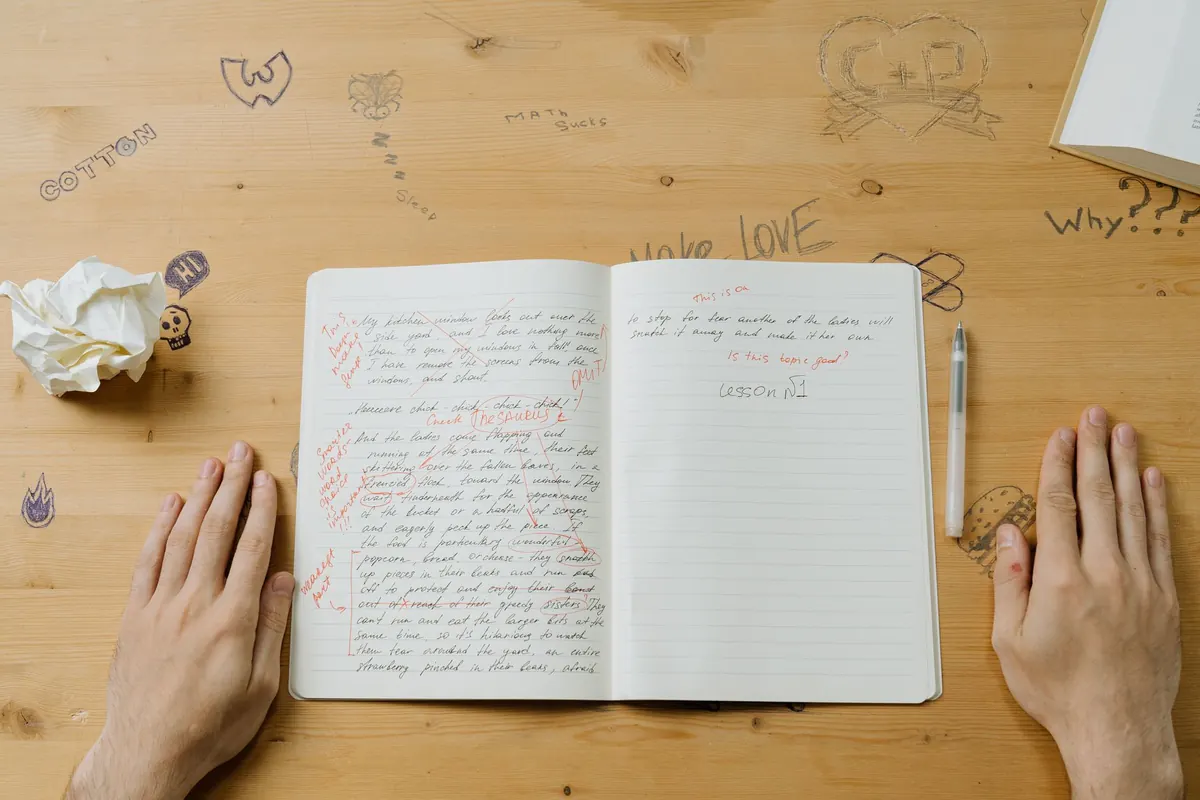
Photo: Yan Krukau / Pexels